


★★★★★
I could explain it perfectly and still not move
Six years of therapy gave me the vocabulary. This gave me the part where you actually do something with it.
 Daniel R.✔Verified customer
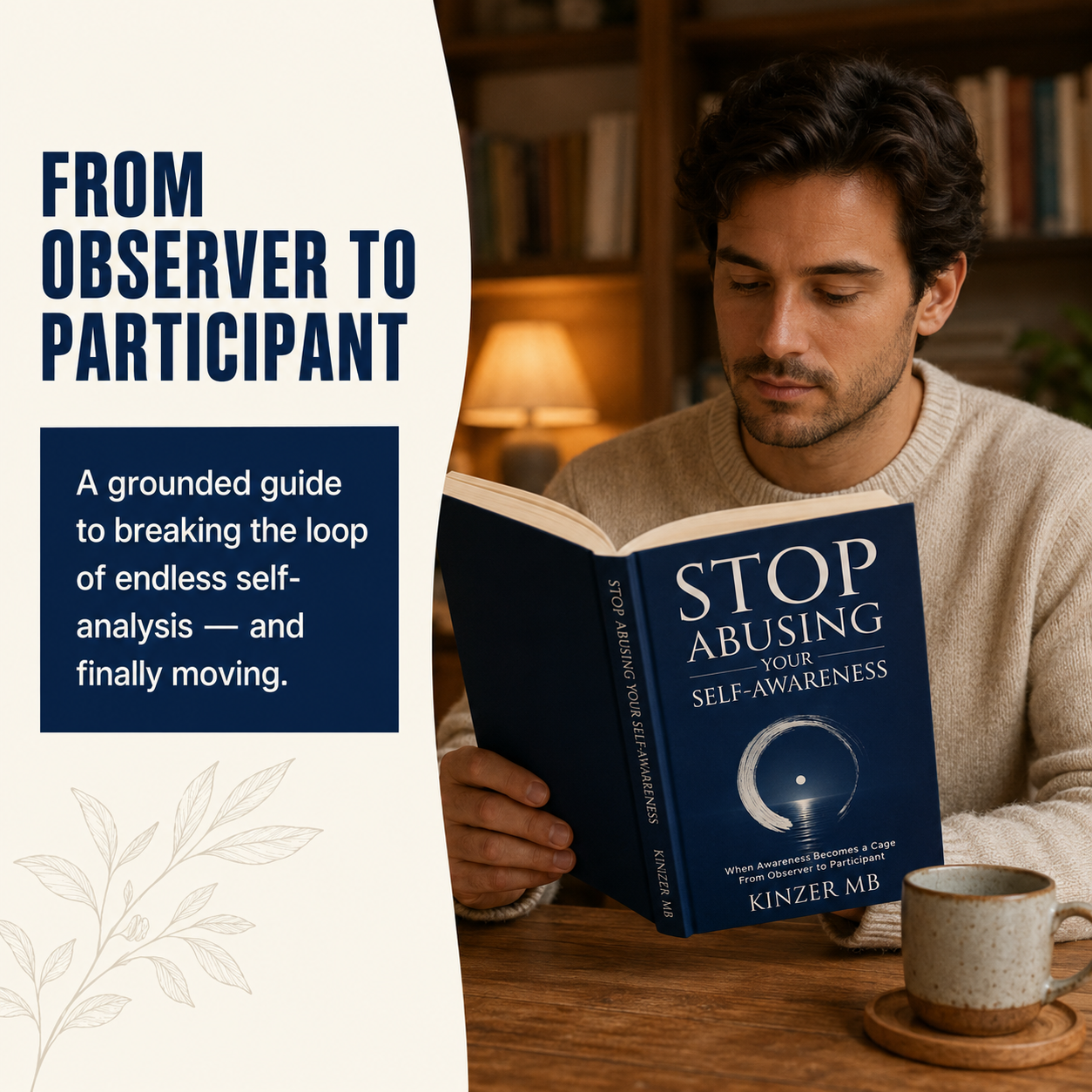
A method for turning self-knowledge into action: how to build confidence from evidence rather than affirmations, and stop analyzing a life you have not started living yet.
Proof-Affirming Actions. Pick the smallest act that contradicts your story about yourself. Do it before you feel ready. Your mind cannot argue with something you have already done.
Stop overthinking without suppressing it. Thought-stopping fails because resistance feeds it. This is the opposite: let the thought run, stop treating it as an instruction, act anyway.
Why isolation reinforces self-doubt. Solitude gives you a confidence no one has contradicted yet. Real rooms, real conversations, real friction is where an identity gets tested.
Couldn't load pickup availability
30-Day
Returns
Read In
One Sitting
Fast
Free Shipping

Six years of therapy and I could explain my avoidance perfectly. This book pointed out that explaining it had become the avoidance.
✔ Lisa R. ★★★★★

Expected the usual repackaged self-help. It spends zero pages convincing you that you have a problem and goes straight to what to do instead.
✔ Hannah M. ★★★★★

Sent the email I'd been drafting for four months. Still not confident, still sent it. Turns out that's the entire point and it actually worked.
✔ Megan T. ★★★★★
You are not stuck because you lack insight. You are stuck because insight became the activity. Watching yourself think, naming the pattern, understanding exactly why you do it — none of that is the same as doing something different. This book is about the gap between the two.
The core idea. You do not think your way into a new self-image, you collect evidence against the old one. Small actions that contradict what you believe about yourself, taken before you feel ready. Confidence arrives afterward, not before.
Time alone is useful until it becomes the only room your ideas are tested in. The version of yourself that feels calm and clear at home has not met anyone yet. This section is on why the confidence built in isolation tends not to survive contact.
Dispatched within 1 to 2 business days with tracking emailed as soon as it ships. Free shipping on all orders.
30 days from delivery. If it isn't what you were looking for, contact us for a full refund.


Six years of therapy gave me the vocabulary. This gave me the part where you actually do something with it.
Daniel R.✔Verified customerIt spends zero pages convincing you that you have a problem. Straight into what to do instead. I read it in one sitting.
 Jen M.✔Verified customer
Still wasn't confident. Sent it anyway. Turns out that's the whole point, and the confidence showed up about a week later.
 Mary T.✔Verified customer
I'd convinced myself the alone time was the work. It named exactly why that version of me kept falling apart around people.
 Hannah K.✔Verified customer
Four abandoned books on my shelf, all stalled by chapter two. This one you open at the page you need and close again.
 Owen L.✔Verified customer
He's the most self-aware person I know and the most stuck. He read it in two nights and hasn't stopped bringing it up.
 Sofia N.✔Verified customer
Three weeks of doing small things before I felt ready. My self-image hasn't caught up yet, but the evidence is piling up.
 James W.✔Verified customer
Ten notebooks of the same realisation written ten different ways. I finally understand why none of it moved anything.
 Amara O.✔Verified customer
Time alone is genuinely useful, right up to the point where it becomes the only room your ideas get tested in. Nobody interrupts. Nobody asks the obvious question. The theory holds because nothing has been allowed to hit it.
The version of you that feels calm and clear at home has not met anyone yet. Confidence built in isolation is confidence nobody has contradicted, which is a different thing entirely, and you find out which one you have the moment you walk into a room.
🚪 The chapter this section comes from is the one people send to each other.

Affirmations fail because the mind checks them against the record and finds nothing. Say you are confident to someone who has avoided every hard conversation for six years, and the mind produces six years of contrary evidence within a second. It is not being negative. It is being accurate.
Proof-Affirming Actions work the other way around. You take the smallest available action that contradicts the story, before you feel ready, and it goes on the record. Then the next one. The belief follows the evidence, which is the order it has always worked in.
◐ Confidence is a conclusion, not a starting condition.
You have done the noticing. You can name the pattern, trace where it came from, and predict exactly how you will sabotage the next thing. This is about the part nobody writes about: what you do on the Tuesday after you understand.
took an action they had been putting off within the first week of reading
said they still overthink, but spend less time deciding before they act
finished it, having abandoned at least one other book in this genre
Based on 1,000+ reader responses, June 2026
Every order comes with a 30-day money-back guarantee. Read it, try one action, see whether the argument holds up against your own life. If it doesn't, contact us for a full refund. No questions asked.
 ”
”
I could describe my avoidance in clinical detail and had never once acted on it. Chapter three got me to send a message I'd sat on since February. Six weeks later I'd renegotiated my salary and moved teams.
Megan H. ”
”
No gratitude lists, no morning routine to fail at. It named one specific thing to do on one specific afternoon. I did it, and the dread I'd built around that conversation was gone before dinner.
Danielle P. ”
”
Six small actions in the first two weeks, each one contradicting something I'd believed about myself since college. I stopped trying to argue my self-image down and just outvoted it.
Kristen O.